
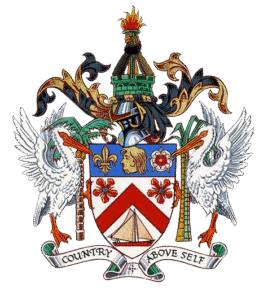
 The National Coat of Arms of Saint Kitts and Nevis is a symbolic “map” of the country’s history, economy, and values. It was adopted at the time of independence in 1983 and serves as the official seal of the federation.
The center of the design is a shield that tells the story of the land’s people. At the bottom, a Carib canoe honors the indigenous Kalinago who first inhabited the islands. Above it, a red chevron represents the volcanic mountains of the islands, flanked by two Poinciana flowers, the national flower. The top of the shield features a Fleur-de-lis and a Tudor Rose, representing the period of French and British colonial rule.
Supporting the shield are two Brown Pelicans, the national birds. They hold a sugar cane stalk and a coconut palm tree, which represent the two historic pillars of the islands’ agricultural economy. Above the shield sits a helmet topped with battlements with a flaming torch held up by the hands and arms of an African, European and a person of mixed decent., symbolizing the “flame of freedom” and the light of liberty for future generations.
At the very base of the emblem is the national motto: “Country Above Self.” This phrase acts as the moral compass for the federation, emphasizing the importance of national unity and service over individual interests.
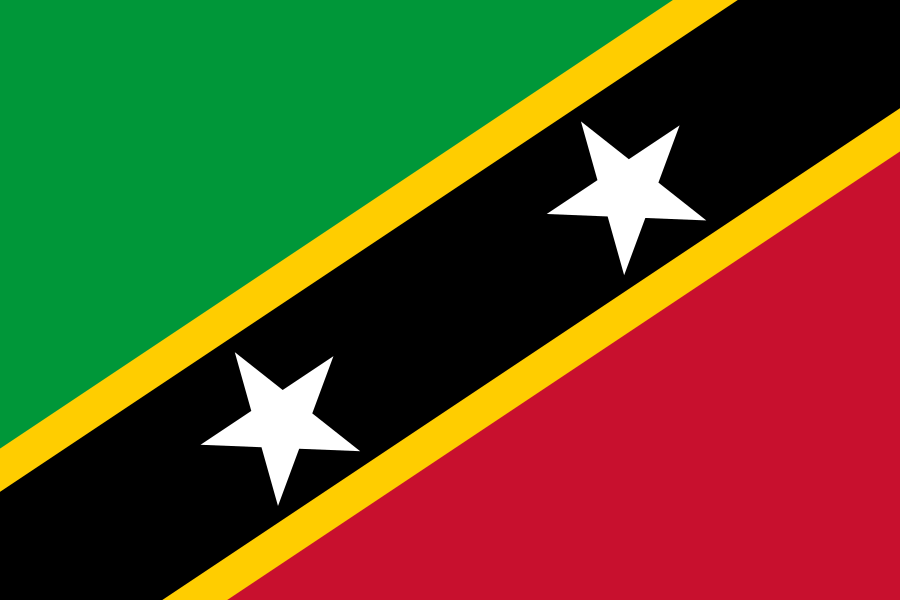
The National Flag was designed by Edrice Lewis in 1983.
Its green triangle represents the islands’ fertile land.
The red symbolizes the struggle for freedom from slavery and colonialism.
These sections are divided by a black diagonal stripe representing African heritage.
The yellow borders for the year-round sunshine.
The two white stars on the black stripe signify hope & liberty.
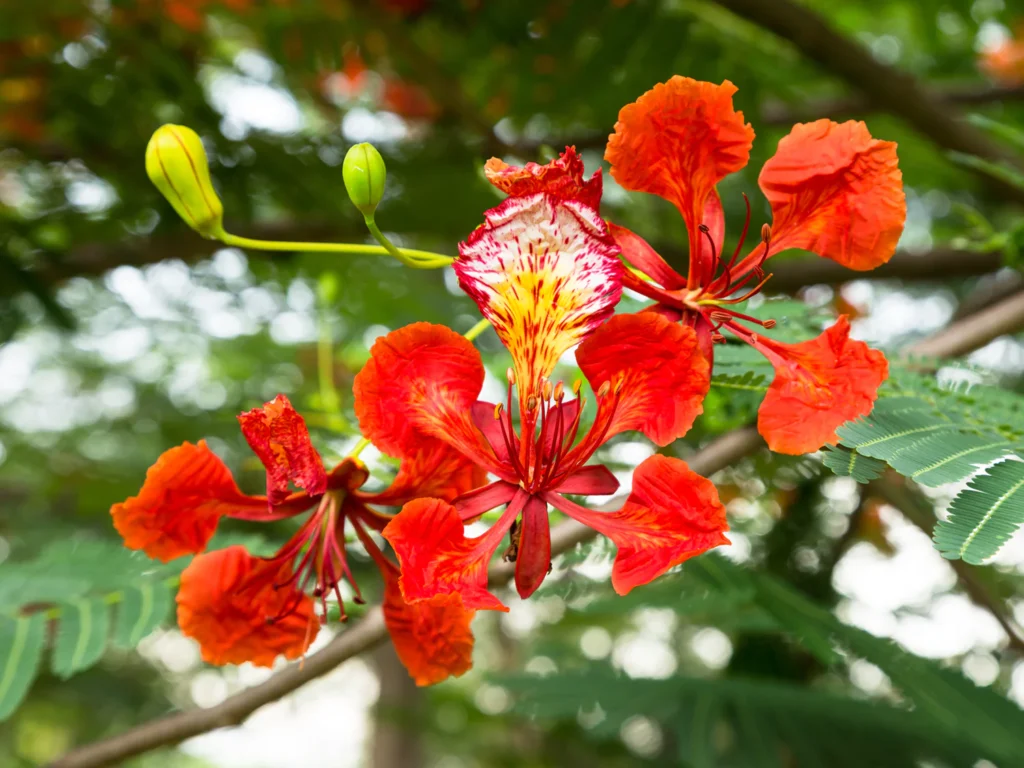
The National Flower of Saint Kitts and Nevis is the Poinciana or Flamboyant, named after Monsieur de Poincy, the first French Governor of St. Kitts, who introduced the plant to the region from Madagascar. The Poinciana represents beauty, resilience, and the island’s tropical climate.
It is known for its “umbrella” canopy and fern-like leaves, but its most famous feature is the explosion of scarlet and orange flowers that appear. Because of this fiery display, it earned the name “Flamboyant” (French for “flaming” or “showy”).
When the flowers fade, the tree produces long, leathery brown seed pods. When dried, the seeds rattle inside, leading locals to call the tree the “Shack-Shack” tree. These pods are often used as traditional percussion instruments in Caribbean folk music.
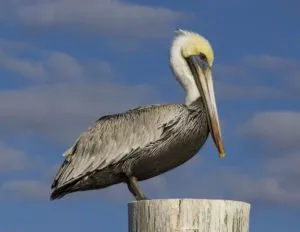 The National Bird of Saint Kitts and Nevis is the Brown Pelican (Pelecanus Occidentalis) or as we locals say the “booby”. It was chosen to symbolize grace, strength, and resilience—qualities that mirrored the young nation’s spirit as it stepped into sovereignty.
When young, it is brown on the head, neck and upper torso of the body, while white below. As it matures, the body becomes dark brown while the head turns white.
Locally, the bird is admired for its “all-seeing” nature and its precision as a hunter, often seen plunge-diving from heights of up to 60 feet to catch fish.
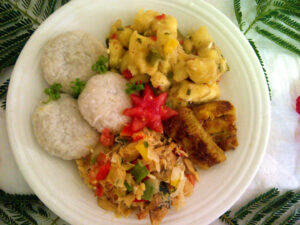 The National Dish of Saint Kitts and Nevis comprises of Stewed Saltfish, Spicy Plantains, Seasoned Breadfruit and Coconut Dumplings.
(Click image for link to recipe).
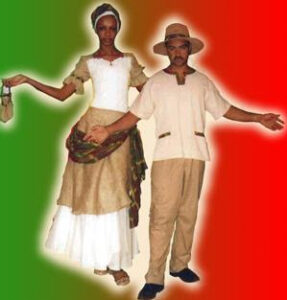
The Saint Kitts and Nevis ‘Official National Wear’ reflects the true ‘Caribbeaness’ of its people. A combination of African and European influences which have shaped the history of St. Kitts and Nevis is evident in both the male and female outfits.
Women’s wear
It was customary for African women to scrap their heads for protection. The main dress is off-white cotton, with a corset top and an ankle-length, wide-flare petticoat bottom. The beige cotton sleeves are short and puffed by using the drawstring.
A short lap skirt made from crocus is worn over the main dress to protect it from dirt. The madras “Cane Soda Wrap”, which was used to cam soda while fertilizing sugar cane, is draped around the waist. The crocus drawstring bag was a safe way for women to secure their mane).
Men’s Wear
A straw hat trimmed with madras offered protection from the hot day’s sun. The short-sleeved, v-neck jack shirt trimmed with madras is made from off-white cotton.
The design is similar to traditional shirts worn by African men. The beige cotton, the ankle-length pant is a reflection of the local fabrics that were commonly used during the colonial period.
 The National Anthem of Saint Kitts and Nevis is titled “O Land of Beauty!” It was officially adopted upon the country’s independence on September 19, 1983.
The anthem was written and composed by Kenrick Georges, a gifted local musician and trumpeter. Unlike many national anthems that focus solely on military triumph or rebellion, “O Land of Beauty!” is a poetic tribute to the islands’ natural splendor and a prayer for continued peace and brotherhood.
I
O Land of Beauty!
Our country where peace abounds,
Thy children stand free
On the strength of will and love.
With God in all our struggles,
Saint Kitts and Nevis be,
A nation bound together,
With a common destiny.
II
As stalwarts, we stand,
For justice and liberty.
With wisdom and truth,
We will serve and honor thee.
No sword nor spear can conquer,
For God will sure defend.
His blessings shall forever,
To posterity extend!