NIA CHARLESTOWN, NEVIS (August 21, 2026) –The following is an interview conducted by Ray de Bono of IMGlobalWealth.news published August 21, 2026:
An exclusive IMGlobalWealth.news interview
IMGlobalWealth.com Editor-in-Chief Ray de Bono speaks with Premier of Nevis Mark Brantley ahead of the Safe Haven Forum in Zurich about geopolitical uncertainty, the changing value of second citizenship, the Caribbean’s economic independence and why Nevis wants to turn safety, stability and sustainability into a new proposition for globally mobile families.
For more than four decades, St Kitts and Nevis has occupied a distinctive place in the history of investment migration. Its citizenship programme, established in 1984, was the world’s first programme of its kind and remains the longest-standing. The official Citizenship Unit describes it as the pioneer of global citizenship programmes.
“I do not believe the Caribbean story has been adequately told internationally. A negative narrative has often taken hold, and we have to become much more effective at explaining what these countries are actually trying to achieve”
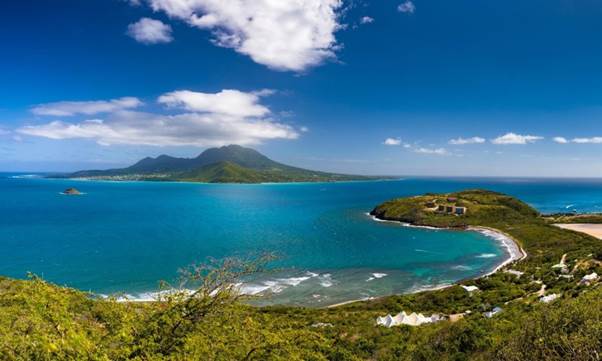
Nevis Peak and Gingerland, from a porch on the Hermitage Hotel
Today, however, the debate surrounding citizenship is changing. Geopolitical fragmentation, conflict, tighter mobility rules and growing scrutiny of cross-border capital are encouraging wealthy families to think not merely about where they can travel, but where they can live, invest and find security should conditions deteriorate elsewhere.
That is also the premise behind Henley & Partners’ Safe Haven Forum, being held at The Dolder Grand in Zurich on 8 September 2026. The invitation-only gathering brings together wealthy individuals, single-family offices, governments and experts to examine access, mobility, security and cross-border resilience in what its organisers describe as an increasingly unpredictable world.
It is against this backdrop that Premier of Nevis Mark Brantley makes a broader case for his island. For Brantley, the traditional Caribbean proposition of “sun, sea and sand” is no longer sufficient. He adds two more elements, safety and security, and suggests a sixth may now matter just as much: stability.
His argument goes considerably further than tourism. Brantley sees small Caribbean jurisdictions as potential safe havens for internationally mobile families precisely because of qualities sometimes overlooked in discussions about passport rankings: democratic institutions, rule of law, political stability, lifestyle, personal security and the ability to establish a genuine second base.
At the same time, he offers a robust defence of citizenship by investment as an instrument of economic self-reliance for small states, while acknowledging that the model itself may now have to evolve.
“There’s sun, sea, sand, safety and security. And some may argue that there is a sixth S now, and that is stability.”
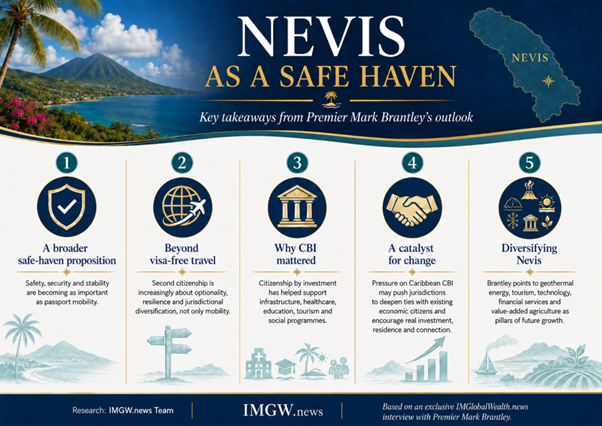
Key Takeaways
The Interview
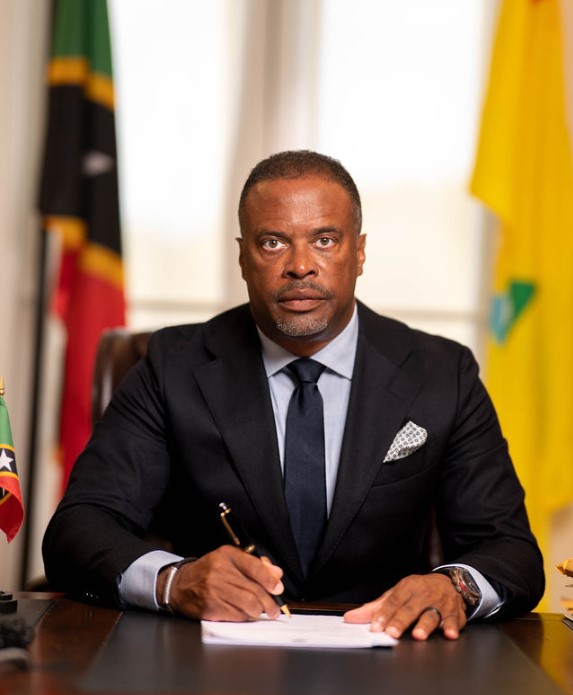
Mark Anthony Graham Brantley, the Premier of Nevis
Question 1: The Safe Haven Forum takes place against a backdrop of growing geopolitical uncertainty, tighter mobility rules and concern among internationally mobile families about overexposure to any single country or jurisdiction. From a Caribbean perspective, what does a genuine safe haven mean today, and what role can Nevis play?
Premier Mark Brantley: There is no doubt that the world is becoming more hostile and that the geopolitical landscape has shifted dramatically.
Countries are devoting increasing amounts of their budgets to defence. That naturally means less money available for social programmes and potentially less developmental assistance internationally.
At the same time, we have seen increasingly strong anti-immigration sentiment in many countries.
For small Caribbean states, this means that traditional partners in Europe, the United Kingdom, the United States and Canada may not necessarily be relied upon in quite the same way as before.
I have said recently that nobody is coming to save the Caribbean. The Caribbean must save itself.
Part of that means islands such as Nevis saying to the world: look at us.
We are offering physical safety and security, but also environmental security because of the way we care for our environment. We offer a stable community, a robust democracy and respect for the rule of law.
We offer an alternative for those seeking safety and security for themselves, their families and their loved ones, and who have the means and ability to come to an island such as ours and, in doing so, contribute to its development.
“There is a certain historical symmetry to the challenge. In 1984, one of the world’s smallest sovereign states helped create an entirely new model of investment migration. More than 40 years later, St Kitts and Nevis may again have to reinvent what that model means”
For many years the Caribbean sold three S’s: sun, sea and sand. Today I believe there are five: sun, sea, sand, safety and security. Some might even say there is now a sixth S: stability.
People want democracy. They want laws that are clear and understandable. They want to know that their investments are protected and that governments will respect those investments.
In St Kitts and Nevis, our final court of appeal remains the Privy Council in London. For some investors, that provides an additional degree of comfort.
And there is something else that we have which should not be underestimated: freedom. Freedom of speech, freedom of movement and freedom of association.
For discerning families and investors, these things are becoming increasingly important
Question 2: Investment migration has traditionally been discussed largely in terms of passport strength and visa-free mobility. Has that sometimes obscured the broader value of jurisdictions such as Nevis, including lifestyle, political stability, security and the ability to establish an alternative place to live?
Premier Mark Brantley: Absolutely.
If we look only at passport strength, we ignore the lifestyle dimension.
Nevis is a beautiful place. We have lush mountains, beautiful beaches, excellent food and a genuine farm-to-table and sea-to-table culture. We have thermal springs that have been enjoyed for centuries. Princess Diana came here on holiday, as have people from around the world who value the privacy and elegance that Nevis offers.
But it goes beyond beauty.
The Museum of Nevis History – Alexander Hamilton birthplace
We have quality education, healthcare, stability, security and personal freedom. You can move around the island without constantly worrying about your personal security.
These are the types of intangibles that can sometimes be lost when the conversation focuses entirely on passport rankings.
I say that as someone who served as Foreign Minister and who worked hard to increase the global mobility associated with our passport. I am proud of what we achieved.
But mobility should not overshadow what the country offers as a place in which actually to live.
We are trying to build a sustainable island state and, if we succeed in what we are seeking to achieve, I believe we can become a model for sustainable small-island development.
“we are already looking towards diversification and finding alternatives to excessive dependence on citizenship-by-investment revenues”
Question 3: Hypothetically, if a St Kitts and Nevis passport no longer provided the same degree of visa-free access to Europe and other major markets, would Nevis still offer a compelling proposition to internationally mobile families and investors?
Premier Mark Brantley: My answer is simple: lifestyle, safety, security and stability.
We have a proven democracy, respect for the rule of law and a cohesive society. We offer a beautiful place to live, work and raise a family.
Mobility may not, in any event, be the only consideration for many high-net-worth individuals.
We are seeing interest in alternative citizenship from people in countries such as the United States and Canada. These are people who already possess passports providing considerable international mobility.
So why are they looking for another citizenship?
It suggests that there are other factors at work.
Just as people engage in asset planning, asset protection and wealth preservation, they are increasingly thinking about migration and jurisdictional diversification as another form of planning.
When I was Foreign Minister, Afghanistan fell back into the hands of the Taliban. We received calls from holders of St Kitts and Nevis passports who were in Afghanistan and wanted to leave. Working with our friends in Qatar, we were able to assist some of those people in getting out.
To me, that is another dimension of safety and security.
People are looking for options for themselves and their families. Even people with some of the strongest passports in the world increasingly understand the value of having an alternative.
Question 4: Does that suggest that visa-free access may become less central to second citizenship over time, with security, optionality and jurisdictional diversification becoming more important? And could that change the way Caribbean governments respond to international pressure on their programmes?
Premier Mark Brantley: Yes.
Mobility will continue to matter to some people, but particularly for people coming from Europe, Canada or the United States, it may not be the primary driver.
We in the Caribbean therefore have to pivot.
We have to look at these programmes and ask how they can become more fit for purpose given the world in which we now live.
We have to make the case that these jurisdictions add value and that what we are creating is something for which there is genuine international demand.
Part of the west coast of Nevis, including the location of Nelson’s Spring
One idea I have strongly advocated is that rather than concentrating almost exclusively on constantly finding new economic citizens, we should look much more closely at the citizens we already have around the world.
Many are high-net-worth individuals.
How do we reach out to them and say: play a greater role in our development?
Bring your business. Bring your headquarters. Bring your family office. Create employment and opportunity. Spend time here. Develop a genuine connection with the country whose citizenship you hold.
That, I believe, could become an important part of the next phase.
Small countries have to accept the world as it is and then adapt intelligently to it. We cannot control geopolitical developments elsewhere. What we can control is how agile we are in responding to them.
“We are pursuing a 30-megawatt geothermal development designed to provide reliable baseload renewable electricity for the Federation. That would be transformative for a small island economy that has historically depended on imported fossil fuels”
Question 5: You have spoken strongly about international pressure on Caribbean citizenship-by-investment programmes. Why do you believe the debate has become so difficult?
Premier Mark Brantley: I think we in the Caribbean have sometimes been misled into believing that this debate is simply about reforming these programmes.
Our programmes have undergone significant reform. Due diligence has become extremely robust, security has been strengthened and we continue to introduce new safeguards.
Yet the pressure continues.
That leads me to believe that there is a broader philosophical opposition to citizenship-by-investment programmes in some quarters.
Migration itself has become an important political issue in many countries. Politicians can very easily associate immigration with pressures on employment, public services or living standards.
We therefore have to confront these issues honestly and explain what these programmes actually represent for small Caribbean states.
We are not asking to become dependent on other countries. Quite the opposite.
We are saying that we want to provide for ourselves. We want to use the intellectual capital that we possess and leverage legitimate aspects of our sovereignty to support our own development.
This is ultimately about sovereignty, independence and sustainability.
Another point that is often lost is that visa-free travel does not normally give someone the right to live or work in another country. It enables visits, generally for limited periods.
That distinction matters.
“Nevis has been involved in international financial services for decades, and we see that as another area that can generate growth”
Editor’s Note: A Programme at a Crossroads
The view looking inland from the Nevis airport
St Kitts and Nevis established its citizenship programme in 1984, making it the world’s first and longest-standing programme of its kind.
The programme now sits at the centre of a wider confrontation between Eastern Caribbean governments and Brussels. In July 2026, Eastern Caribbean leaders said that a European Commission letter dated 25 June had requested that the region’s CBI programmes be phased out by 1 June 2028, with a 24-month transition period proposed. The request has intensified regional discussion about economic diversification, replacement revenues and the future relationship between citizenship programmes and visa-free access.
That makes Brantley’s argument particularly timely. For Caribbean governments, the question is increasingly not simply whether CBI survives in its present form, but what economic model follows if its role diminishes
Question 6: If CBI revenues were to decline significantly over the coming years, how prepared is Nevis to replace that income? Where do you see the most credible sources of future growth?
Premier Mark Brantley: Number one on my list is renewable energy.
The science has demonstrated that Nevis has significant geothermal potential. We are now moving towards commercialising that resource and developing production capacity.
We are pursuing a 30-megawatt geothermal development designed to provide reliable baseload renewable electricity for the Federation. That would be transformative for a small island economy that has historically depended on imported fossil fuels.
But I see geothermal as more than simply producing electricity for Nevis.
Our wider resource potential is much greater than our domestic requirements, which means that over time there could be opportunities to supply neighbouring islands and to use affordable renewable power to support new economic activity.
I have said publicly that I want us to become, metaphorically, the Norway of the Caribbean, except that our resource would be renewable energy.
That would itself become part of the lifestyle proposition. Imagine living in a Caribbean jurisdiction where your energy is generated from renewable sources.
Tourism will, of course, remain important.
Technology is another area in which I see considerable potential, including digital services and ensuring our people have the skills necessary to participate fully in the new economy.
Then there are financial services. Nevis has been involved in international financial services for decades, and we see that as another area that can generate growth.
Agriculture, including value-added agriculture, is another opportunity.
So we are already looking towards diversification and finding alternatives to excessive dependence on citizenship-by-investment revenues.
“What citizenship by investment created was an additional stream of non-tax revenue in an economy where, because of our small size, the amount that can be raised through domestic taxation is naturally limited”
Pinney’s Beach | Nevis
Question 7: Could the pressure on Caribbean CBI actually prove to be a catalyst? Do Caribbean jurisdictions now need to persuade economic citizens not merely to acquire citizenship, but actually to spend time there, invest, establish businesses and build a genuine connection with their adopted country?
Premier Mark Brantley: Yes. I call it the connectivity factor.
I believe we need to pivot away from a model that focuses primarily on acquiring more and more new citizens and start asking how we can create deeper relationships with the citizens we already have.
I once met a gentleman in Dubai from a very wealthy Yemeni family. He told me that 43 members of his family had St Kitts and Nevis citizenship.
Then he asked me: “Is it a real place?”
I smiled, but the question was very telling.
What it demonstrated was that we had not done enough to tell that citizen: You are welcome. Come and see us. Holiday here. Invest here. Bring your experience, knowledge and capital. Become involved in helping to develop the country whose citizenship you have chosen.
That conversation has not happened enough.
I believe the present pressure could become a catalyst for precisely that.
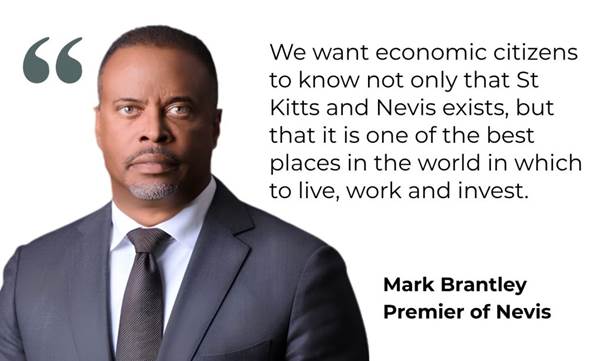
We want economic citizens to know not only that St Kitts and Nevis exists, but that it is one of the best places in the world in which to live, work and invest.
Question 8: Looking towards 2030, do you expect citizenship by investment still to remain at the heart of the Caribbean proposition, or will a broader model emerge based on residence, investment, genuine connection and cross-border resilience?
Premier Mark Brantley: I do not believe citizenship by investment will simply disappear, but I do believe the emphasis will change.
We need to repurpose, repackage and reimagine these programmes.
Rather than simply chasing larger numbers of new citizens, we should persuade existing citizens to live here, spend time here, invest here and become more involved in these countries.
At the same time, we are working to diversify our economies so that investors and citizens know they are becoming associated with jurisdictions that are economically advancing and not dependent on any single source of income.
By 2030, I think we will see a fundamental shift.
The pressure we are now experiencing could be the catalyst for that shift.
We have to wake up. We have to become active and agile. We have to use the intellectual capacity that we possess.
And we have to tell our story better.
I do not believe the Caribbean story has been adequately told internationally. A negative narrative has often taken hold, and we have to become much more effective at explaining what these countries are actually trying to achieve.
Question 9: St Kitts and Nevis pioneered citizenship by investment more than four decades ago. Looking back, what has the programme actually delivered at ground level for Nevis and for the wider Federation?
Premier Mark Brantley: Citizenship by investment has given us the economic space to expand our economy in a significant way.
It has expanded our tourism product. Hotels have been developed through the programme. It has supported real estate development.
We have built roads, hospitals and schools.
We have supported our elderly, people in need and those who are differently abled.
What citizenship by investment created was an additional stream of non-tax revenue in an economy where, because of our small size, the amount that can be raised through domestic taxation is naturally limited.
That revenue has helped put St Kitts and Nevis on a trajectory towards achieving its sustainable development objectives.
There is another element that I would like readers in developed countries to understand.
The more independent and resilient we are, and the more revenue we can generate ourselves, the less dependent we become on international assistance.
We are attempting to make our own way.
The world is dealing with climate change, war, geopolitical tensions and a breakdown in some of the international norms that we took for granted only a few years ago.
For Caribbean countries, our message is that we want the freedom and the space to develop responsibly.
These programmes have played a critical role in our development and have helped reduce our historic dependence on external assistance.
As we say here in the Caribbean, we are paddling our own canoe.
Conclusions: From Passport to Place
Brantley’s argument reflects a potentially important shift in the Caribbean investment-migration story.
For much of the past four decades, citizenship programmes have been marketed largely around a relatively straightforward exchange: qualifying investment in return for citizenship and the mobility attached to it. That equation is becoming more complicated.
If geopolitical fragmentation continues and wealthy families increasingly regard jurisdictional diversification as a form of insurance, the value of a second citizenship may become less dependent on how many borders its passport can cross and more dependent on the credibility of the country behind it.
In that world, democracy, rule of law, physical security, political stability, energy resilience, healthcare, connectivity and quality of life become part of the investment-migration calculation.
This is where Brantley believes Nevis has an opportunity. His proposition is essentially to move from passport to place: from acquiring citizenship principally as a mobility instrument towards developing an actual relationship with a jurisdiction that can serve as a second home, investment base or safe haven.
It also requires the Caribbean to confront an uncomfortable economic question. CBI has provided governments with revenue that Brantley says has helped fund infrastructure, education, healthcare, tourism and social support. If international pressure reduces those flows, diversification can no longer remain an aspiration. It becomes an economic necessity.
Nevis’s geothermal ambitions are therefore more than an environmental project. They form part of a wider attempt to build an economy supported by renewable energy, tourism, financial services, technology and agriculture rather than by any single revenue stream.
There is a certain historical symmetry to the challenge. In 1984, one of the world’s smallest sovereign states helped create an entirely new model of investment migration. More than 40 years later, St Kitts and Nevis may again have to reinvent what that model means.
For Brantley, the answer is no longer simply citizenship. It is connection, resilience and a credible place to go when the world elsewhere becomes less predictable.